
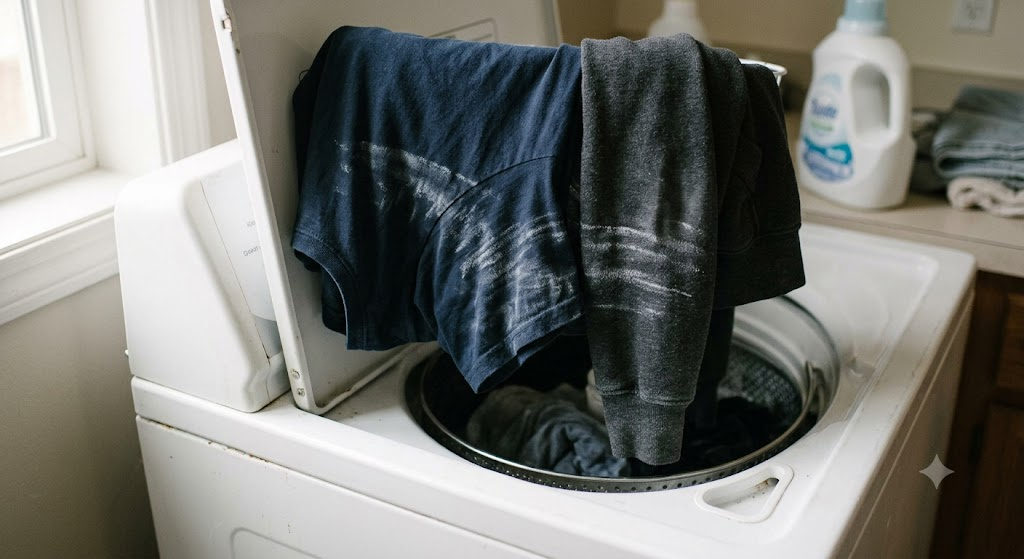
White residue on freshly washed clothes is a sign of either mineral deposits or that the detergent didn’t rinse out properly during the wash cycle. The residue is usually undissolved detergent, but it can also come from hard water minerals, fabric softener buildup, lint, or gunk inside the machine. Several things can look the same. The challenge is that all these different causes produce white residue that looks very similar on clothes. It’s hard to tell them apart at first glance. Simply changing detergent brands usually does not solve the problem if the real cause is overloading the machine or hard water minerals.
Rewashing the clothes without identifying the root cause typically just repeats the problem. You end up with the same white residue again. The blog post will cover the main causes, how to identify which one is affecting your laundry, and simple steps to stop the problem for good. By the end, you’ll have a much better idea of why those white marks showed up in the first place and how to keep them from showing up again.
What Does the Residue Look Like?
We just want our readers to be a little more observant. Before you go around blacking your detergent, it is wise to take a moment and examine the residue closely. How the white marks look can provide important hints about the real cause. A quick and easy test is to rub the residue lightly between your fingers. This tactile check helps differentiate causes. If the residue feels dry and powdery, leftover detergent is probably the suspect. If it feels waxy, greasy, or slippery, fabric softener buildup is usually responsible. If the white marks look like small fibres or pieces of paper, a tissue left in clothing is a common cause that is easy to identify. This simple finger test can prevent a lot of trial and error. It helps you identify the likely cause faster.
| What You See | What It Could Be |
| White powder that brushes off easily | Undissolved detergent |
| Chalky streaks | Hard water minerals |
| Small white flakes | Buildup inside the washer |
| Fuzzy white pieces | Lint or tissue left in a pocket |
| Sticky white marks | Fabric softener residue |
Can Too Much Detergent Leave White residue on Clothes?
Yes. Too much detergent is a frequent cause of white residue. Ironically, using extra detergent to get clothes cleaner usually results in white marks that make them look less clean. The tendency to use more detergent is very relatable. People naturally think if the recommended amounts work, adding extra should work even better. This is a common assumption that leads to overuse of detergents. But it does not improve cleaning and usually ends up leaving white residues on clothes. Detergent requires sufficient water to fully dissolve, move through the clothes, and remove dirt and rinse away cleanly. If you use too much detergent for the amount of water and load size, the machine cannot rinse it all out. Excess detergent remains on the clothes, and leftover detergent dries on the clothes and appears as white or powdery residue after the cycle.
A simple way to picture it
Too Much Detergent
│
▼
More soap than water can handle
│
▼
Detergent stays in the fabric.
│
▼
White marks appear after washing.
Signs You’re Probably Using More Detergent Than You Need
Check out these signs that indicate you are using more detergent than you need:
- Clothes that feel a bit rigid or crunchy after drying indicate detergent residue that didn’t rinse out properly.
- White or powdery lines on dark clothing after washing are a classic sign of excess detergent that was not fully rinsed away.
- Excessive suds during the wash cycle usually mean too much detergent was used for the load size and water amount.
- Towels that feel heavy, coated, or less absorbent after washing often have detergent buildup on the fibres.
- Clothes that have a clean scent but still feel slightly off or not fully fresh usually have a detergent residue left behind.
Adding extra detergent does not improve cleaning results but just creates a problem instead. Extra detergent forces the machine to work more to rinse everything out, which can lead to residue and other issues.
Why Doesn’t the Detergent Dissolve Completely?
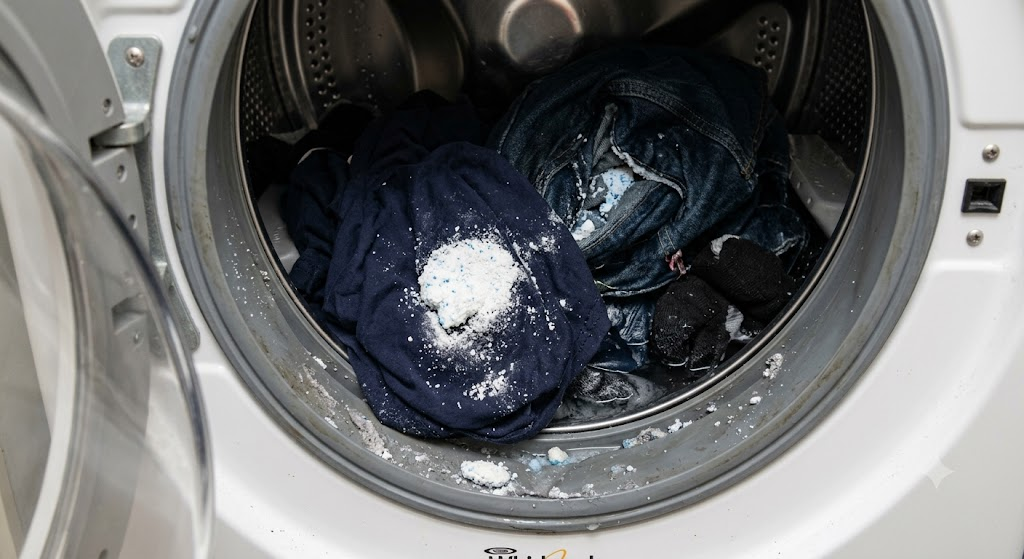
This problem is not the same as simply using too much detergent. It can happen even when you follow the recommended amount. Even with the right quantity, white residue can appear if the detergent fails to fully dissolve in the water. The issue is dissolution, not quantity. Powder detergent is the most common type that causes this problem. It is more prone to incomplete dissolving. In cold water, powder detergent usually fails to dissolve fully before the machine moves to the rinse cycle. Cold water slows down the dissolving process. Undissolved powder particles stick to the clothes instead of washing away. These particles become visible residue after drying.
Undissolved powder particles stick to the clothes instead of washing away. These particles become visible residue after drying. White or light colored powder residue shows up much more clearly on dark fabrics, making the problem more noticeable. Liquid detergents dissolve more easily than powder, but they can still leave residue in some situations. They are not foolproof. Pouring liquid detergents straight onto dry clothes (instead of the dispenser) can cause concentrated spots that don’t rinse out well.
Things that affect how well detergent dissolves
- Water temperature
- Type of detergent
- Water pressure
- Wash cycle selected
- How full the washer is
If you have switched detergents and suddenly started seeing residue, the detergent itself may not be the problem, but may simply need different wash settings,
Powder Vs. Liquid Detergent
| Powder vs. Liquid Detergent | Powder Detergent | Liquid Detergent |
| Stain Performance | Works well on many everyday stains | Mixes quickly with water |
| Cold Water Use | Can leave residue in cold water | Less likely to leave powdery marks |
| Dissolving | Needs enough water to dissolve | – |
| Dosage | – | Easier to measure for smaller loads |
Neither powder nor liquid detergent is inherently superior. The focus should be on proper use rather than choosing one type over the other. What really matters is using the correct amount of detergent and making sure there is enough water for it to dissolve and rinse properly. Proper dosage and water volume are more important than the type of detergent.
Can Hard Water Leave White Marks on Clothes?
Absolutely. Hard water can indeed cause white residue. Many people incorrectly blame their detergent when the actual problem is the hard water supplied to their home. Hard water naturally has high levels of minerals like calcium and magnesium. These come from the local water source. These minerals are safe for humans, but they react with detergent and reduce its effectiveness. When detergent mixes with hard water minerals, it forms a residue that does not rinse out well. This residue is left on the clothes after washing.
The white marks or dullness from hard water buildup get worse gradually with repeated washes. Dark clothes develop a grayish or dusty appearance due to mineral deposits. White towels and linens can look full or dingy over time because of mineral buildup. Clothes can feel stiffer or rougher because the minerals leave a coating on the fabric. The detergent itself is not the problem or suddenly low quality. The hard water minerals are interfering with the detergent’s ability to clean and rinse properly.
Common signs of hard water
- White spots on glassware
- Mineral deposits around faucets
- Soap that takes longer to lather
- Towels that feel rough after drying
- White film on darker clothes
Can Fabric Softener Leave White Residues?
It can. This might surprise a lot of people because fabric softener can leave residue, as they expect it to improve clothes and not leave marks behind. The fabric softener product is not bad by itself. The issue is typically caused by using too much or adding it incorrectly during the wash cycle. The main purpose of fabric softener is to leave a thin coating on the fibres of the clothes. This coating is what makes clothes feel softer and reduces static after drying. When too much is used, or it is poured straight onto dry clothes instead of the dispenser, the softener does not distribute evenly. This leads to uneven coating.
The uneven softener leaves visible white streaks or patches that become obvious after the clothes dry. Dark fabrics usually show the white streaks more clearly, but light coloured clothes can also be affected.
Could Your Washing Machine Be the Reason for Residue?
When clothes come out less than clean, most people assume they used too little detergent, the wrong cycle, or overloaded the machine. But that’s not always the case; the routine itself might be fine, but the real issue could be inside the washing machine. Over time, the appliance accumulates its own dirt and grime, and that buildup can transfer back onto clothes during the wash cycle. So even with perfect habits, a dirty machine will undo all your efforts. Take a moment to consider all the stuff that goes into your washer over twelve months, not just water and detergent but all the mess from dirty clothes. It’s a lot more than you might think, and most of it does not just go down the drain.
Even when your clothes come out looking clean, fresh, and spotless, the machine itself is quietly collecting leftover gunk in multiple hidden spots. The drum, the drawer where you pour soap, the filter, the rubber seal around the door, and the drain pipes. After weeks and months of accumulation, all that trapped residue reaches a point where it’s staying hidden and starts transferring back onto the clothes you just washed. That’s when you notice dull colors, musty smells, or strange film on fabrics.
Places where residue likes to hide:
| Part of the Washer | What Can Build Up |
| Detergent drawer | Soap residue |
| Fabric softener compartment | Sticky deposits |
| Rubber door seal | Lint, moisture, and dirt |
| Drain filter | Hair, lint, coins, small debris |
| Inside the drum | Detergent and mineral buildup |
Final Words
Some items like thick comforters, large blankets, or a week’s worth of family clothes are physically too big for the average home washer to handle well. Home washing machines are not designed to carry such a big volume or bulk. When you try to wash oversized items in a small machine, the results are most likely to be disappointing.
At CoinLess Laundry, you will find clean, high-capacity washers and dryers that are built for bulky household items and everyday family laundry. Whether you want to wash large-sized clothes or several bags at the same time, we offer a spacious self-service machine that can handle large laundry loads much more easily. Reach out to our team in any of our 50+ locations across Arizona.
Frequently Asked Questions (FAQs)
Q.1. Is white residue on clothing permanent?
Not in most cases. If it results from the use of detergent, fabric softener, or mineral deposits, another rinse or wash cycle will get rid of it.
Q.2. Is it possible to have white residue using liquid detergent?
Yes. Though it is more common when using powder detergent, too much liquid detergent or overloading the machine can lead to the presence of white streaks.
Q.3. Why do only my dark clothes have white residue?
This problem is more visible on dark clothes because of the color difference. The same residue on a white shirt would remain invisible to the eye.
Q.4. Is it necessary to wash clothes again when noticing the white residue?
If the reason is in the use of detergent or fabric softener, a simple rinse cycle would be enough. It is recommended to determine the cause before washing the load again.
Q.5. Will it help to wash clothes in a bigger machine?
In case of bulky loads, yes. Blankets and comforters require sufficient space for proper circulation of water and detergent. White residue tends to remain in the clothes when a machine is overcrowded.
Q.6. Does using a larger washing machine help?
For bulky items, it often does. Comforters, blankets, and heavy bedding need enough space for water and detergent to circulate properly. When a washer is packed too tightly, residue is more likely to stay trapped in the fabric.