
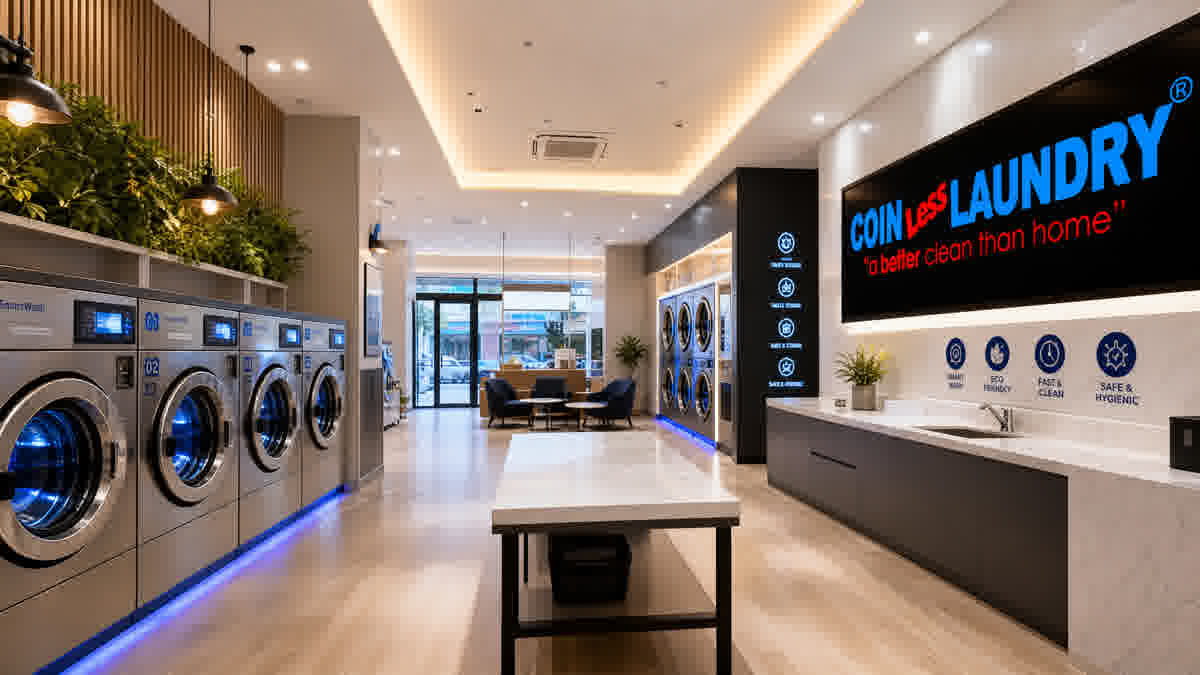
Self-service laundromats have changed a lot from the old model of simple washers. There were simple machines called “washaterias” with manual dials, and customers used to wait anxiously to see if the wash would finish properly. At that time, they operated by renting you electric washing machines on an hourly basis. But now laundromats have transitioned from mechanical dials to digital smart card systems. They are being improved by subtle but effective automation features every passing year. Features like automatic timers, sensors that detect every move, alerts when cycles are completed, and easier-to-use machine controls.
Users also benefit a lot from these features, as it gives them a lot of time and there is less need to keep checking machines. Laundromat owners also get better control over how machines are performing and experience fewer technical issues. And these transformations are not only to look more high-tech but to fix those small annoyances that used to make the laundry experience inefficient. For laundromat businesses, fast service, convenience, and customers returning regularly for their services are important. So every little change adds significant value to the overall business. So, machine automation in laundromats is no longer just a futuristic concept. It’s a way to simplify the customer experience and run the business more smoothly.
This blog post highlights how automation has come a long way and is helping both laundromats and customers in improving the laundry experience.;
How Automation is Making Laundromats Easier for Customers?
Self-reliance is important because it preserves the core idea of self-service while making the whole experience more pleasant and efficient. In the past, using a laundromat was simple: people brought their laundry and used to wait for quite some time to finish their laundry. The basic laundry structure has not disappeared, but what has changed is what customers expect from the experience. Of course, any customers today would want clear instructions on how to operate machines, how to run them on reliable schedules, and avoid unexpected problems during washing. Customers no longer want to waste time waiting for a machine to be available. Laundry automation helps make this overall process easier.
Rather than forcing customers to figure out what each machine is doing, newer machines use lights, screens, and automatic notifications to provide clear updates and save them from getting confused. These changes may seem small, but in a self-service setting where there is no staff help. Even little improvements have a big cumulative effect on the customer experience. When machines clearly communicate what is happening, a normal laundry trip becomes much easier and less stressful for the customer. On the other hand, machines that are hard to operate in the first place can make users feel intimidated and will take more time to figure out how to use them.
Automation is not taking away the self-service concept. Instead, it is improving and updating it for users. Customers can follow the process on their own without having to ask staff for help or clarification.
What Does Laundry Automation Look Like In Practice?
Laundry automation is a bunch of small features working together to make a big impact. All these small functions combine to simplify both using the machines and running the business.
- Digital timer displays exactly how much time is left for a cycle to complete, which helps users plan their waiting time better.
- Automated cycle controls make each wash and dry cycle more consistent and reliable. Built-in sensors can automatically adjust water levels, wash time, or other settings according to how full the machine is.
- Notification systems can alert customers when a cycle finishes or when a machine requires maintenance.
- Easy-to-read lights or displays at a glance show how a machine is free, in use, or finished and ready.
- Automatic shut-off features stop machines when the cycle is complete, and it prevents unnecessary running and saves energy.
So it doesn’t matter what technology you are using, but what really counts is the practical results for customers and operators both.
How Do Timers Improve the Experience?
Digital timers are among the easiest and most helpful automation features in laundromats. They provide basic but important information to customers. Timers show exactly how much time is left in the cycle. This means customers do not have to keep walking back to check on their laundry. These single features make the entire laundromat visit feel smoother and less time-wasting. Customers can leave the machine for a few minutes, plan what to do next, or handle other tasks while knowing exactly when to return. Timers contribute to a more organized and predictable rhythm throughout the laundromat.
With visible remaining time, customers are less likely to gather around machines or worry that a cycle is delayed because they have a clear expectation of timing, which reduces annoyance and stress during the visit. In a self-service laundromat, being able to predict when things will finish is a real convenience for customers. Customers may not consciously think about predictability, but they notice and appreciate it when the laundry process feels easy. Customers may not consciously think about predictability, but they notice and appreciate it when the laundry process feels easy. For laundromat owners, timers contribute to a smoother and more organised flow of customers.
With timers, businesses rely less on staff having to remind customers or manually monitor machines. When customers can see the remaining time, they are less likely to interrupt staff or other customers with questions. During busy periods when many machines are in use, this clarity becomes especially useful. It helps the entire laundromat run more calmly and efficiently.
How Do Sensors Help Machines Adjust Better?
A major improvement that has proven most useful in laundromat automation is the smart response achieved with the help of sensing systems. The behavior of a washing machine can be adapted according to the contents in the drum instead of using the same method consistently. This helps to improve balance, prevent damage to fabric, and contribute to the consistency of cleaning.
That’s what’s important because the amount of clothes we put into the washer isn’t always even. Some customers come with a little mixed basket, some customers come with heavy towels, and then some customers fill the drum more than necessary. A flexible enough machine will be more apt to cope with those variations. It can prevent too-aggressive cycles (for a lighter load) or too calm (for a heavier load).
The practical benefit is easy to understand. Items are washed more efficiently, with less hassle involved, and the machine does a better job of using the resources. That can also minimize fabric usage and therefore customer perception of unnecessary usage over time, without reference to technical detail. A smart machine that adapts performs better in developing a sense of trust. It encourages users to feel the machine is working for them rather than pushing the same approach against their will.
How Do Alerts Improve Store Flow?
One of the most useful, yet least talked about components of today’s washing machine automation in laundromats is alert systems. They eliminate the need for customers to continually check machines and also aid the operator in responding quickly when attention is needed. For instance, a wash completion alert will assist the customer in knowing if that wash or dry cycle has completed, instead of them standing near the machine throughout the cycle. This makes the entire process more laid-back and less dull.
There is also a practical store-management side to alerts. When a machine is signaling “issues,” the operator can take precautions to fix the problem before it becomes a bigger service interruption. When finished and the customer is clearly informed, the machine may be returned to use sooner. This optimizes the overall flow of the laundromat and ensures that machines aren’t sitting idle.
Alerts also minimise awkward situations. It is less likely that customers will overlook the end of the cycle, forget what they are loading, or get confused about the status of the machine. These small problems can have more impact in the self-service environment than a person may initially think. A good warning system can take these issues out of the process and smooth out the entire process.
How Does Automation Help First-Time Users?
Lots of stress associated with self-service laundromats is due to uncertainty, particularly for individuals who are visiting the laundry for the first time. They might not have an idea about which machine to use, how long the cycle will take, or even coordination for putting clothes in the washer and dryer. Automation takes some of that uncertainty away from the process since it’s easier to read and execute clear information.
When the machine provides unambiguous feedback, it will make the user feel more at ease, and the machine will feel less intimidating to first-time users. They have no excuse for going about things by trial and error. A simple indicator when the cycle is over, and a clearly defined, visible timer to make the experience a little more structured. This is a big plus for businesses that serve the customers themselves, as an individual who feels good after the first visit will be more inclined to come back.
The emotional effect matters too. Laundry is a routine task, not a learning exercise. People want it to be easy. The more the mental workload is reduced, the more the laundromat can become easier to trust. It’s that trust that can turn a one-time customer into a repeat user.
How Automation is Transforming the Customer Experience
When we talk about transformation, the biggest change automation brings is not always visible in one feature. It becomes part of the general impression and shows up a little bit in the overall feeling of the whole visit. Customers are aware whenever the space appears more predictable, the machines work clearly, and customers aren’t standing around with no idea of timing. Those details affect how the laundromat is remembered. These specifics are small b, but they all impact how the laundromat is remembered.
A smoother experience can manifest itself in several ways:
- Customers do not repetitively check machines.
- The process is more orderly from beginning to end.
- You’re less likely for your users to feel uneasy about choosing the right setting.
- One rinsing and drying of the steps is easier to handle
- It may feel more modernised and reliable to the laundromat, but it’s not complicated
It’s not a place that has to look high-tech just for that reason. The idea is to make it more convenient. Customers are most interested in the first place when they enter a laundromat. They want something that works, something that’s repeatable, something that doesn’t add needless friction in a room. All three are helped by automation.
What Do Operators Gain Behind The Scenes?
On the operator’s side, there’s another automation value: it reduces the staff on-call workloads and makes the business more likely to remain consistent, particularly in a ‘self-service’ scenario when employees can’t be present at all times. Clearer signals in the machines, easier tracking of the cycles, and a smarter response system make it easier to understand what is happening throughout the store without having to constantly check on each unit.
This is important because laundromats operate on the flow of customers. Machines must move, customers must flow, and the store should also be easy to control during busy times. Automation aligns with that, with them being more transparent about how the machine performs and easier to monitor and track. If a unit is misbehaving, it can be identified quicker. For cycles that are completed, the machine can be utilized more quickly. Machine behavior may be easier to understand and less is likely to be a complaint if a customer is confused.
Final Words
At CoinLess Laundry, we believe self-service laundry should feel like a simple, fast, and stress-free process. That is why we have high-quality, modern machines to make your laundry experience smoother. We want our customers to be more efficient and make their every visit feel easier to manage and more comfortable to use. If you are looking for a laundromat experience that feels more organised and customer-friendly, CoinLess Laundry is your go-to laundromat in Arizona.
Frequently Asked Questions (FAQs)
1. What is machine automation in a self-service laundromat?
Machine automation includes such elements as digital timers, cycle control, automatic adjustments depending on the sensor data, and alerts.
2. How does machine automation make the use of the automated laundry machine convenient for customers?
Machine automation helps customers better monitor the washing process and makes this process more understandable and less confusing for them.
3. Will the clothes be washed better in an automated laundry machine?
The clothes will be washed consistently well since the machine will regulate the washing process considering the quantity of the laundry inside the drum.
4. How can alert systems be useful in a self-service laundromat?
The alert system is helpful since the customer will see when the cycle finishes and the operator will receive notifications about machine problems.
5. Is the self-service laundromat more convenient for the first-timers?
Yes, since the instructions on how to use the machine and its status will be more understandable and visible for the first-timer.
6. What is the greatest advantage of machine automation in a self-service laundromat?
It makes the laundromat more efficient and reliable for customers.